Translate

Il ministro dei trasporti Buttigieg e suo marito hanno adottato due gemelli


Pete and Chasten Buttigieg welcome twins

BY JORDAN WILLIAMS   (The Hill)


Transportation Secretary Pete Buttigieg announced on Twitter that he and his husband, Chasten Buttigieg, have welcomed twins into their family.

Pete Buttigieg shared a photo to Twitter of the couple holding the babies, named Penelope Rose and Joseph August.

“Chasten and I are beyond thankful for all the kind wishes since first sharing the news that we’re becoming parents,” he said. “We are delighted to welcome Penelope Rose and Joseph August Buttigieg to our family.”

Chasten and I are beyond thankful for all the kind wishes since first sharing the news that we’re becoming parents. We are delighted to welcome Penelope Rose and Joseph August Buttigieg to our family. pic.twitter.com/kS89gb11Ax— Pete Buttigieg (@PeteButtigieg) September 4, 2021

The couple first announced in mid-August that they were going to become parents but didn’t share any further details at the time.

According to The Washington Post, the pair had been trying to adopt a child for a year. Earlier this year, the couple almost adopted a baby from a mother in labor, but then the mother changed her mind about putting the child up for adoption.

Chasten Buttigieg told the newspaper that the adoption process was a “really weird cycle of anger and frustration and hope.” When asked what the couple would say to their future child, he said, “We tried so hard for you. We waited so long for you.”

New Zealand supermarkets take knives off shelves after 'extremist' stabbing


by Reuters

By Praveen Menon

WELLINGTON, Sept 4 (Reuters) - New Zealand supermarket group Countdown said on Saturday it has removed knives and scissors from its shelves, a day after a man the authorities called an Islamist extremist stabbed six people in one of the company's stores.

"Last night, we made the decision to temporarily remove all knives and scissors from our shelves while we consider whether we should continue to sell them," said Kiri Hannifin, Countdown's general manager for safety.

"We want all of our team to feel safe when they come to work, especially considering the events of yesterday," she said in a media statement.

Other supermarket chains had also removed sharp knives from sale, local media reported.

Police shot https://www.reuters.com/world/asia-pacific/new-zealand-attacker-shot-dead-after-injuring-people-mall-2021-09-03 dead the attacker, a Sri Lankan national who cannot be named due to court suppression orders. Prime Minister Jacinda Ardern said the man was inspired by the Islamic State militant group and had been under constant police surveillance.

Police were following the man when he went into the Countdown supermarket in New Lynn mall in Auckland. They said they had thought he had gone in to do some shopping, but he picked up a knife from a display and started stabbing people.

Police said they shot him within a minute of the start of the attack. Three of the six victims are in critical condition.

Ardern said the attacker had been under surveillance since 2016 because of his support for a violent ideology inspired by the Islamic State. By law the man could not be kept in prison, so he was being constantly monitored instead.

The government has sought an urgent lifting of the suppression orders so more details on the person could be made public. Ardern is expected to address the media at 0200 GMT.

(Reporting by Praveen Menon; Editing by William Mallard)

Our Standards: The Thomson Reuters Trust Principles.

Le macchine che si autoriproducono. E gli uomini

The Road to Self-Reproducing Machines
Advances in technology will soon allow us to build machines that replicate themselves and evolve like living beings


ILLUSTRATION: TOMASZ WALENTA

By Frank Wilczek (The Wall Street Journal)

Nobel Prize-winning physicist Frank Wilczek explores the secrets of the cosmos. Read previous columns here..

Throughout history, creative human engineers have taken inspiration from artifacts of the biological world. Leonardo da Vinci designed flying machines, submarines and tanks with birds, fish and tortoises in mind. Today, artificial neural nets, a computer architecture directly inspired by animal nervous systems, are the cutting edge of machine learning. But none of those applications get to the deep structure of biology—likely a beacon of future creativity.

As the Nobel Prize-winning biologist Paul Nurse explains in his recent book “What is Life?,” the deep structure of life is the existence of physical units (cells or organisms) that can reproduce themselves, allowing small variations. Those ingredients—reproduction and variation—together drive evolution by natural selection. They generate a diverse population that can survive changes and exploit new opportunities.

Remarkably similar tricks, working on different scales, underlie many other key biological processes. Embryos develop from single cells into mature organisms after several stages of growth (in humans, a few dozen), where each stage differs a little from the previous. Thus, the fertilized egg’s diverse progeny eventually includes heart, liver and brain cells. The “right” kind of cell emerges in response to signals in its local physical and chemical environment, in a kind of guided miniature evolution.

Self-reproducing machines could unleash the power of exponential growth, thus enabling audacious engineering projects.

Though he worked in equations and diagrams rather than artistic renderings, John von Neumann was a visionary modern engineer on the level of da Vinci. At the time of his death in 1957, at the age of 54, von Neumann was well into a major new project. His unfinished manuscript, edited by Arthur Burns into the book “Theory of Self-Reproducing Automata,” is monumentally impressive. In it, he gives precise designs for mathematical models of objects he called “universal replicators.” They consist of three basic parts: a machine A that can gather resources and assemble things following a program, a program B that instructs A how to make desired products, and a master program C that instructs A how to make A + B + C.

The news of the week in context, with Tyler Blint-Welsh.
I would also like to receive updates and special offers from Dow Jones and affiliates. I can unsubscribe at any time.

Von Neumann provided a rigorous, detailed design for a system of this kind operating within a recognizable simplification of the real world. Technically, it would be a cellular automaton within a bath of randomly scattered pieces that it can scavenge for parts. Exploiting modern technologies, you could in principle elaborate on his designs to make a hybrid 3D printer/computer system that collects material to build something you want plus a copy of itself. It wouldn’t be hard to incorporate life’s other secret ingredient—that is, variation—either by deliberate programming or by loose quality control.

As scientists master the art of making molecular machines according to plans encoded in DNA, von Neumann’s vision will get closer to practicality. It’s worth remembering that his early computer designs, which date from the era of vacuum tubes, likewise outstripped available technology.

Self-reproducing machines could unleash the power of exponential growth, thus enabling audacious engineering projects. They might bring the science-fiction dream of terraforming astronomical bodies within reach. Most profoundly, by embodying biology’s deep structure, they would blur the distinction between life and non-life.

Il Gran viaggio in Italia: Baja Sardinia bagnata


La First Lady e' tornata a scuola


Jill Biden returns to the classroom, live and in person
Jada Yuan 

Among the thousands of teachers heading back to the classroom this fall will be one in Alexandria, Va., who likes her students to call her “Dr. B.”© Carolyn Kaster/AP Jill Biden stands in front of a podium at the Evan G. Shortlidge Academy in Wilmington, Del., on Sept. 1.

Jill Biden is the first first lady to maintain a full-time job outside the East Wing. Soon she’ll have another first under her belt: the only first lady to teach a hybrid-learning community college class in the midst of a terrifying surge in a raging global pandemic.


“Can you believe it’s almost time to begin the new school year?” she asked a socially distanced crowd at Waipahu High School near Honolulu in late July. “I hope you’re as excited as I am for those clean whiteboards, the freshly waxed floors, and, best of all, the bright faces of our students — in person.”

Starting the week of Labor Day, Biden will be spending every Tuesday and Thursday for 13 weeks on the Alexandria campus of Northern Virginia Community College (NOVA), according to a class schedule available to students. When she taught remotely last semester, she had a similar schedule and blocked off most of her day — 8 hours, from early morning until after 4 p.m., for two three-hour lectures per day and a lunch break in between — to concentrate on teaching. She’ll even have office hours, just like last semester. But this time around, instead of talking into a computer, she’ll be commuting to work from the White House by motorcade, will be teaching in a mask and will have a phalanx of Secret Service agents with her.

All 18 slots in her morning section of College Composition I, which teaches students how to write academic essays, are filled already. Her courses will be combined with English Composition Readiness II, for students who need a little extra writing help, says NOVA’s dean of Liberal Arts, Jimmie McClellan. Biden’s been teaching some version of these classes since she joined NOVA’s faculty in 2009, when her husband became vice president. She was a trailblazer then, too: the only second lady to hold onto her professional career.Where Jill Biden drops by for a cup of coffee can make quite a statement

Biden has made her preference for in-person versus remote teaching clear, advocating for a return to classrooms since the start of the administration.

It’s a stance that has become more controversial amid deadly surges of the delta variant. It puts Biden, who usually stays away from hot-button issues, at the center of a national war about masking in schools and vaccination requirements that has already led to parents getting into physical altercations with mask-wearing teachers in Texas and Northern California, and showdowns between city school superintendents and their state’s Republican governors in Texas and Florida. And now, with the Food and Drug Administration’s approval of the Pfizer-BioNTech vaccine, school districts around the country are issuing vaccine mandates for teachers and staff, in New York City, Chicago and San Antonio, as well as the entire states of New Jersey, Washington, California, Connecticut and Oregon.

Biden, who makes a point of wearing a mask in most public settings, is in many ways the face of the administration’s positions on mask and vaccine requirements in schools — positions that the majority of Americans approve of, according to a new poll, but which nonetheless set off fierce opposition. She’ll be returning to a NOVA campus that has been a landing site for refugees who fled Afghanistan after her husband’s decision to withdraw U.S. forces from the country and the chaotic collapse of its government.

As the “Teacher in Chief,” as her peers have called her, she’s also the one person in the White House who is heading back out to the front line of the pandemic.


© Anna Moneymaker/AP First lady Jill Biden tours a classroom at the James Rushton Early Learning Center in Birmingham, Ala., on April 9.

“I think it’s really hard to learn on Zoom, don’t you?” Biden asked a fifth-grade writing class during a visit to a school in Concord, N.H., in March. “I think it’s really hard, but I still get to know my students just like your teacher does.”

According to CBS News, Biden asked to return to campus in January, but the college denied the request because they were limiting the number of people on-site. She’s talked about missing the energy of a great discussion and her worry for the mental health of her students, particularly those who lost family members because of the coronavirus.

“Like all educators, the first lady cannot wait to get back into the classroom with her students,” says her press secretary, Michael LaRosa. “She is looking forward to teaching and communicating in person rather than through the screen.”

Biden has spent the last few weeks out of the public eye in Wilmington, Del., with some time in Washington, Camp David and their home in Rehoboth Beach, Del., working on her syllabus and lesson plan, as is her tradition before the start of every school year. She’s also been recovering from a foot injury. When she walks up to her lectern, she will be masked, as will all of her students, per a Virginia mandate. Seating will be socially distanced, says Dawn Selak, director of communications for NOVA. Biden will have no way of knowing whether her students are vaccinated; the Virginia Community College System that governs NOVA nixed a vaccination mandate in May. But Selak says the community college has been encouraging all students to get vaccinated and providing a $250 incentive.

Biden’s classes are listed as hybrid, meaning students will spend 50 percent or more of their time meeting in person, with some online learning, but “that’s just in case that there is a need for it,” says a senior White House official who spoke on the condition of anonymity to be candid about internal planning.

The Secret Service detail assigned to follow her everywhere on campus will probably be bigger and more intense than the one she had when she started teaching at NOVA in 2009.

As second lady, she successfully barred the Secret Service from casing her classroom. “I couldn’t have them sitting right there in the front row — the students would be too intimidated,” she wrote in her memoir, “When the Light Enters.” At her request, they ditched their dark suits and dressed like college students, carrying their protective equipment in backpacks so they could better blend in, and guarded a seating area down the hall from her classroom.

“I hoped not only that my students would not notice there were Secret Service agents nearby, but also that they wouldn’t even realize I was the Second Lady,” Biden wrote. “And as unlikely as it seems, many of them didn’t.”In Jill Biden’s Vogue cover, there’s optimism and rebuke

Biden’s classes are often listed on course schedules as being taught by “staff.” Sometimes she uses her middle name and the instructor field reads, “Tracy, J.”

“She had a lot more anonymity and traveled with less of an entourage,” the White House official says — although there will probably be efforts to slim down the motorcade so as not to make such a scene every time she drives through Virginia.

Out of more than 50 NOVA students who wrote anonymous reviews of her on the site RateMyProfessors.com, only one alluded to her other job. “With all on her plate, she still puts in time, effort and concern for her students. I mean, who — in her position — would continue here with all that’s going on in her family’s very public life? But in the classroom she’s simply Dr. Biden,” the review read.

Most other reviews have effusive praise (“She has a big heart and passion for education,” says one. “101% worth it,” says another). But plenty of others gripe about Biden assigning way too much homework. “Super tough grader! Lots of writing! Not sure how any student can make it out her class!!!” says one recent review.


© Carlos Barria/AFP/Getty Images First lady Jill Biden visits a classroom in May with protocols to avoid the spread of the coronavirus disease in Salt Lake City.

Biden has built her public profile around being a teacher and mentions it at nearly every event she’s held as first lady. “I’m a teacher, and everything I do is evidence-based,” she told people in a drive-through vaccination center in Orlando, to try to get them to take the coronavirus shot. “As a teacher, as a mom and grandma, I wanted to be able to give the best answers I could. So I asked some experts,” she said at another vaccination event in Jackson, Miss.

Her first lady schedule is built around teaching, not the other way around. While she taught remotely last semester, the press corps, staff and Secret Service sometimes waited a full day on certain trips to California and Navajo Nation so she could stay on Zoom before returning to the White House.

Biden’s teaching career began in 1976, a year after she met and started dating then-senator Joe Biden, with a job teaching English at a private Catholic high school, she writes in her memoir. She then worked at several other high schools, was a reading specialist for Black students at a newly desegregated high school, and taught history and English to teenagers in a psychiatric hospital.

She says that once she started teaching at community colleges — first at Delaware Technical Community College and then at NOVA — she never looked back. She frequently talks about her admiration for her students, who are often older than conventional college students and looking for a fresh start after being veterans, single parents or refugees.

When the Obama-Biden ticket won in 2008, Biden started getting emails from McClellan, NOVA’s dean of Liberal Arts, encouraging her to teach there. “For eight years, counter to the advice of several senior advisors, I lived a ​​double life,” between her office in the White House and her cubicle filled with family photos and crayon drawings from her grandkids at NOVA, she writes in her memoir. She’s taught there ever since, including through the years that Donald Trump was president.

Biden has kept a protective bubble around her teaching life. The week after President Biden’s inauguration, she found out that her White House role was to be mentioned in a flier distributed on campus, according to a CBS News report on NOVA emails obtained through a public records request. “I am an English teacher at NOVA — not First Lady,” she wrote in an email to fellow faculty, explaining that she didn’t want her students to view her differently. “Thanks for honoring my teacher identity. Jill,” she signed off.

Finding a way to teach as first lady wasn’t easy. Biden’s salary is $85,999 for the nine-month 2021-2022 school year, according to a faculty employment contract obtained by the College Fix. The Constitution’s emoluments clause prevents the president from profiting from the U.S. government or any of its states. Although the clause doesn’t apply to the first lady, the Bidens file taxes jointly, and NOVA is a state school — which creates a potential conflict of interest. The college settled on paying Biden through the NOVA Foundation, a nonprofit that raises private funds, CBS News reported.

Teaching, as Biden writes in her memoir, is “profoundly optimistic.” Returning to the classroom next week, with coronavirus cases rising, as her husband issues evermore forceful edicts about masks and vaccination, may be Biden’s next act of profound optimism.

He bought a cheap house in Italy.

This is what happened next
Silvia Marchetti, CNN 

(CNN) — Italy's cheap homes bonanza continues to lure hundreds of interested buyers, despite the pandemic. But what happens once someone takes the plunge and invests their (small) chunk of change in a crumbling corner of a remote town?
For Roy Patrick, a 67-year-old British car and motorbike fanatic who bought an old school house in the northern mountain village of Carrega Ligure for about $16,500, it's been an adventure -- not without mishaps such as a falling chimney and a jammed door -- and also a joy.

Patrick, from Oxford, bought the property after finding himself in the village, in the mountains on the border of Italy's Piedmont and Ligure regions, almost by accident.
He arrived after disembarking from a post-divorce Mediterranean cruise in the port of Genoa, where he met people who told him about the wonders of the village. He decided to visit and take a look and was fascinated by the place.
After touring several old properties he fell in love with the 1930s school building and bought it in 2017.
"The other houses were nice but had nothing special, they could have been in any little Italian village tucked away in alleys," says Patrick. "But this one was particular, the view is unique: the way the sun goes down over the mountains when it sets, you'd say 'wow.' It's my personal Arcadia, my Nirvana, therapeutic place."

The property, which was offloaded by the local town hall as part of an initiative to boost the populations of communities in decline (similar to many being operated across Italy), is located in the quiet neighborhood of Connio, where just 12 people live.

Since the purchase, he's been visiting every two weeks -- even during the pandemic. He does business in Italy buying and reselling old three-wheeled vehicles. He says he's found a new family in the town and a bucolic haven for detoxing and unplugging amid fresh air.
Carrega, he adds, has many charms.
"Top of the list is the friendliness of the local people, followed by the stunning views I get as I gaze out of the windows looking across the valley. Mine is the best panorama in the village.
"Also, I am extremely lucky to have, a few short meters away, a fountain which is fed by the invigorating cool water coming down from the mountain peaks."

Chimney collapse
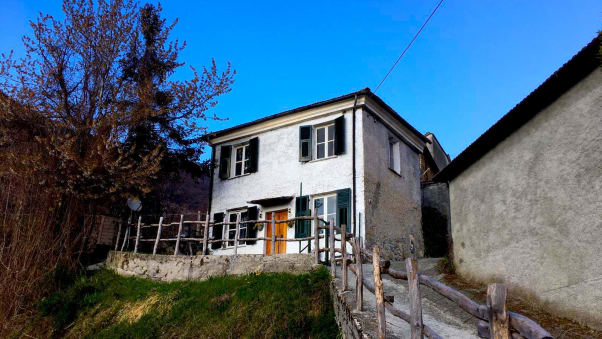

Patrick Roy's house cost $16,000 and needed minimal renovations.
Courtesy Roy Patrick
Patrick says his initial encounter with his new home was less than promising.
He recalls that the mayor had to climb up a ladder to enter a window in order to open the building up. It had been shut for decades and the door was jammed, with the keys nowhere to be found.
A later structural disaster turned into a positive story. When one Christmas Eve an unstable chimney collapsed due to heavy snow, one of Patrick's neighbors volunteered to climb onto his roof to make it safe. Patrick says he was astonished when the man refused to be paid.

People are welcoming, he says, they want to help newcomers and don't want anything in return. At the most, a glass of heady red wine to sip together.
Related contentTraveling to Italy during Covid-19: What you need to know before you go
Patrick says he's made plenty of friends in the village and enjoys his Italian dinners with them.
During the minimal renovations needed to make the old school habitable, Patrick says he's unearthed a treasure trove of historical finds.
In the attic, he discovered relics from the building's former life: dusty piles of old text books, inkwells, glass bottles, pupil registers and other quirky items harking to the bygone days when 20 pupils were taught in what is now Patrick's living room.
On the doorstep there's a mosaic with Roman numerals indicating the year the school was built. Patrick has decided to keep the original tile floors and wood-covered walls.
Carrega, where many people are selling their empty family homes for as low as $12,000, also feels frozen in time in many ways.

Quiet life
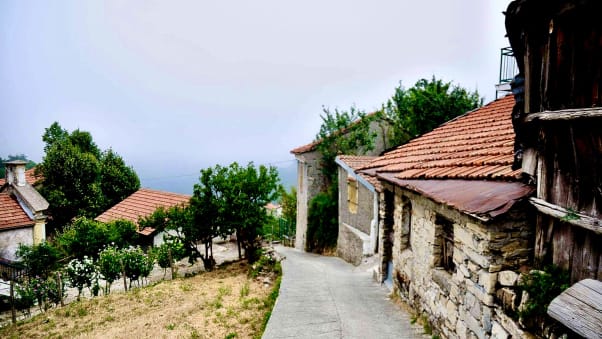

The sleepy village is miles from the nearest shops, bars or restaurants.
Courtesy Comune Carrega
Located in the Apennine mountains, it's scattered across 15 inhabited districts and two ghost hamlets. In one neighborhood there are just two residents. People wave at each other and chat from their window balconies.
While Carrega has been offloading cheap properties for a few years, officials are still occasionally putting up abandoned buildings for auction. A few crumbling houses were recently sold for between $6,000 and $7,000. Another lot of two properties has just been placed on the market.
Patrick has some advice for those tempted by the thought of buying a house up here: don't expect any social buzz and be prepared for bumpy, tricky roads.
There's absolutely nothing, he says, just great views, silence, pure air and pristine surroundings. No bars, supermarkets, shops or restaurants. A vehicle is essential to move around.
Related contentThe millennials using Covid to change Sicily's €1 home schemes
However, Carrega does spring to life in the summer, when day-trippers and vacationers arrive to relax.
"There's this one night when all the young people get together and throw a huge rave party with loud music till the next morning," says Patrick. "Otherwise it's just chirping birds and utter silence. I feel guilty if I am using a chainsaw."
The two-floor school has thick stone walls and tall ceilings. It does, says Patrick, get very cold in winter when unoccupied for a few weeks and takes a while to warm up. When snow piles up, it's a tough job clearing a path to the door.
Patrick handled the entire renovation of the schoolhouse himself -- plumbing and heating upgrades included. He repainted the outside walls white, and livened up old yellow shutters with a coat of green paint.
Rewiring was tricky, he says.
"The wiring was typical of a small old Italian village -- scary-thin and not suitable for modern tech equipment. I could turn on only the lights, nothing else, not even the microwave. It had few kilowatts of power and kept tripping."

'Dreadful' kitchen
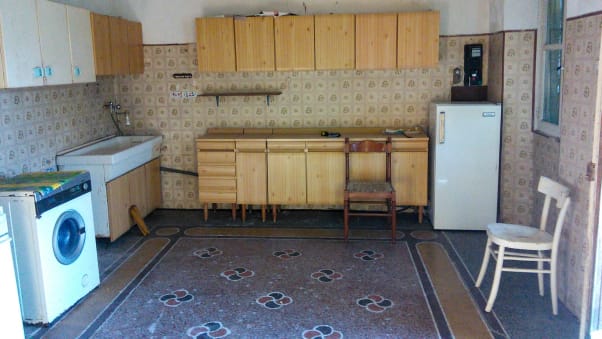

Patrick says he ripped out the 'dreadful' old kitchenette.
Courtesy Roy Patrick
The house had some fixtures when Patrick bought it, but he disposed of the "shockingly dreadful" kitchenette that had been used by the family who lived there after the school shut. For furniture, he toured local flea markets, keeping an eye out for unusual items.
"The interior decor is eclectic, there's a bit of modern and retro: a typical Italian marble table, old wooden kitchen furniture, bucolic paintings, the head of a mummified wild boar, a comfy sofa chair. Red is the predominant color. There's a red stove, a red microwave, red kettle, red chairs. I have a lovely, electric blanket to keep me warm which is my luxury."
Patrick says he has a love-hate feeling for the pine paneling that covers the interior walls. His first impulse was to tear it out, but since it was in a good condition and creates a warm ambiance, he decided to leave it in place.
"I still pinch myself, can't believe my luck," he says. "The school was in great shape, the ceilings were beautiful. The big restyle is done but it's still a work-in-progress, each time I visit there's something to do. I never relax, always working on small fixes. I like spending time thinking about how to improve things."
When not mending, Patrick passes the time cooking and listening to music -- when locals hear the melodies playing from his window they know he's back in town and it's party time.
Even though the renovation hasn't cost him a fortune given that the property was far from dilapidated, it hasn't all been plain sailing.
Related contentThese beautiful Italian towns will pay you to work remotely
Patrick says he needed to bring scaffolding to fix and paint the outside -- which he recalls as quite "a dangerous task" -- and had to fit a new shower in the bathroom as there was just a toilet.
"I had to battle through a series of problems," he says. "In the UK I know exactly where to go to buy the tools and materials I need. But in Carrega I had no idea. So first, you need to find out where to drive to and which store or person to look for before you start the work, you need to plan it."
Another catch was that he struggled to insure the house given that it is located, like many beautiful parts of Italy, in an earthquake-prone area.
The best advice Patrick wants to share with people thinking of buying a home in Carrega is to think carefully beforehand.
"Apart from a weekly delivery of cheese with people knocking at doors, there's absolutely nothing at all in the village."
Provisions must be bought from the nearby village of Cabella, which though less than 10 miles away, takes more than 30 minutes to reach along a road littered with hairpin curves.
"Believe me, it's not a nice drive along those narrow mountain roads, particularly when they're covered with brand new virgin snow. It can be scary."

Il Gran viaggio in Italia: Baja Sardinia # 3

Sono le tre del mattino a Washington e le nove di sera a Baja Sardinia.

Mi telefona mio figlio Max, appena arrivato a casa nostra nella Capitale federale da Veracruz.

"Papa', mi dice con una certa apprensione, Qui sembra che crolli tutto. Tuoni, fulmini, tonnellate di acqua. L'uragano IDA adesso e' arrivato anche qui."


Le foto pubblicate qualche ora dopo dal Washington Post motrano strade della Capitale invase dall'acqua e canotti di vigili del fuoco che cercano di salvare qualcuno in pericolo.

Ci tornano alla mente le immagini e le sensazioni vissute personalmente il 4 novembre del 1966 durante l'Alluvione di Firenze.

Qui a Baja Sardinia ci godiamo il panorama mozzafiato della Maddalena con i super yacht dei super ricchi mondiali in visita .


Bagno veloce nel mare favoloso di una spiaggetta a dieci minuti di strada da casa mia.


Clark e Cris, carissimi nostri amici di Washington, hanno trovato il tempo e la voglia di unirsi a noi per qualche giorno ed e' un gran bel regalo la loro vicinanza.

Lasceremo la Sardegna il giorno 11 settembre imbarcandoci ad Olbia per Civitavecchia.

Non possiamo avere il green pass obbligatorio per tutti i mezzi di trasporto a lunga distanza perche' non siamo residenti in Italia ma in America.

Ci siamo muniti della copia di una disposizione del Ministero della Salute Italiano che considera come un green pass le certificazioni dei vaccini fatti negli Stati Uniti, insieme all'ultimo tampone fatto prima della partenza da Washington, unitamente al Passenger Locator Certificate.

Sara' dura convincere chi dovra' controllarci all'imbarco che questa documentazione e' regolare.

Abbiamo fatto il pieno alla nostra 500 L (come 'lenta') ed il proprietario della stazione ci ha detto che e' incredibile la maleducazione delle masse di turisti che si sono riversate nell'isola nel periodo di Ferragosto. 

"Ci costringeranno a fare come a Venezia, imponendo il numero chiuso."

Tim di Arzachena: Cosimo e Giulia sono due ottimi professionisti. Rimettono a posto i nostri cellulari.